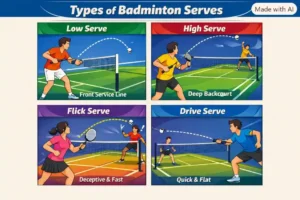
The serve in badminton is crucial because it kicks off every single rally and basically sets how the whole point is going to go. Even though the rules don’t let you hit it super hard, mixing up different types of serves like low, high, flick and drive serves keeps your opponent confused and makes the serve a really important part of your game strategy.
Types of Serve in Badminton
Low Serve
The low serve in badminton is basically a short, controlled shot that barely gets over the net and drops down close to the front service line. It’s the go-to serve in doubles matches and is also used in singles play because it keeps your opponents from being able to smash the ball and makes them have to lift it up or stay really tight at the net.
How to Perform a Low Serve
- Get into a steady position close to the front service line (in doubles).
- Grip the racket with your backhand and make sure your thumb is supporting it.
- Keep the shuttlecock down below your waist with the cork pointing forward.
- Move it forward with a soft motion using your wrist and fingers instead of making a big arm movement.
- Direct it just over the net so it drops down near the front line.
- Make sure the serve stays smooth and low so your opponent can’t attack it easily.
High Serve
The high serve sends the shuttlecock way back into the opponent’s backcourt and it’s used a lot in singles play. The main reason players use it is to force their opponents to move back and give themselves time to get ready for the next shot. You need to make sure the serve goes really high and really deep so the other player can’t smash it back at you.
How to Perform a High Serve
- Mainly used in singles matches to force your opponent to the back of the court.
- Position yourself sideways with most of your weight on your back foot.
- Swing using a forehand underhand motion, making contact below your waist.
- Aim high and deep toward the back boundary line.
- Concentrate on getting good height and distance rather than hitting it hard.
- The best high serves come down steeply right near the back line.
Flick Serve
The flick serve is a tricky shot that seems like a low serve at first, but then gets flicked up high and fast toward the back of the court. Players use it a lot in doubles to keep their opponents from running up to the net too quickly, though if someone figures out what’s coming early enough, they can hit it back hard.
How to Perform a Flick Serve
- Great for catching your opponent off guard in doubles play.
- Begin with the same motion as a regular low serve to keep them guessing.
- Right before you hit the shuttle, snap your wrist and forearm quickly.
- The shuttle will shoot forward fast and land deep in the back of the court.
- You have to make it fast and unexpected because if it’s too slow, your opponent can easily smash it back.
Drive Serve
The drive serve is basically a fast, straight serve that’s mostly used in doubles play to put pressure on your opponents and take control of the point. You need to be really accurate with it and hit it low over the net but if you mess up and hit it too high or too far, your opponent can easily take advantage and punish you for it.
How to Perform a Drive Serve
- A quick, flat serve that targets the opponent’s body or open spaces on the court.
- Keep your feet steady and hold the racket around your waist.
- You can throw with either a forehand or backhand grip.
- Strike the ball flat and keep it just over the net.
- This works great in doubles because it makes your opponents react fast but it’s pretty risky if you’re playing singles.